12 Internal Tools Your Agency Can Build for Your Team
An internal tool is anything your team uses to get more work done, whether that is an automation, a repeatable process, an app, an AI skill or a simple front end. Most agencies scale by hiring. A better route is to build tools that multiply each person's output. Twelve good places to start are listed below.
- An internal tool is anything your team uses internally to increase their output, in any form.
- The aim is to multiply your people, not replace them: each specialist gets a small team of tools behind them.
- Twelve starting points: media buyer, copy generator, video editor, onboarding agent, image ad generator, competitor research, sales coach, SOP hub, client results tracker, client memory, testimonial collector and project manager.
- Pick one tool, build it with low code or AI, and put it in your team's hands this week.
- A client results tracker that flags churn risk early is one of the most useful tools to build first.
What is an internal tool in an agency?
An internal tool is anything your team uses internally to increase their output. The definition is wide on purpose. A tool can be an automation, a process (a repeatable workflow your team runs), an internal app, a skill you train an AI on, or a simple front end your team interacts with.
The test is simple. If your team uses it to get more work done, it is an internal tool. In most cases it is built for your team rather than for your clients, although some agencies also build client portals or tools that clients can use.
Why build tools that multiply your team instead of replacing it?
The idea is to take repetitive work and give one person, or a small team, more leverage. This is not about firing media buyers, client success managers or designers. It is about giving each of them a team.
In practice that means an editor who now has the editor plus several AI editors, a strategist who has a whole research team to call on, or an account manager who has a reporting assistant and a communication writer. We call this the multiplier effect. Agencies that build these tools handle more work with the same people, which is why the approach matters for scaling capacity.
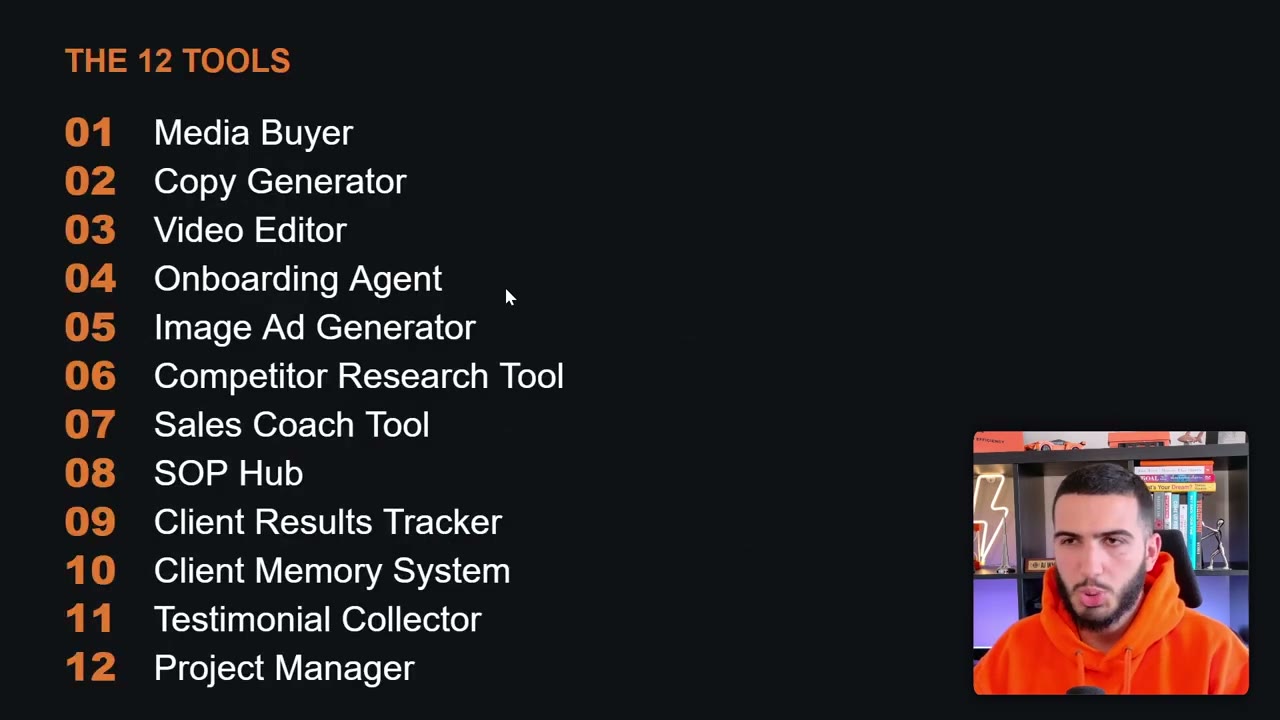
Which 12 internal tools should an agency build?
Each of these replaces a slow, manual job with a tool that does the repetitive part and leaves the judgement to your people.
- Media buyer. Lives in the Meta Ads Manager for your clients, manages ads, creates campaigns and adjusts spend, instead of a person checking every account every day.
- Copy generator. Writes client copy from your winning ads, tailored to each client using their onboarding notes, instead of writing every variation from scratch or using an outdated template.
- Video editor. Cuts ads, adds B roll and layers in calls to action automatically, instead of a video editor spending hours on a single ad.
- Onboarding agent. Runs the client onboarding from kickoff to launch, sets up the accounts and tells the client exactly what is needed, instead of repeated kickoff calls and chasing assets.
- Image ad generator. Produces a large batch of creatives in minutes instead of a designer mocking up each variation by hand.
- Competitor research tool. Pulls competitors' ads, landing pages and offers into one brief instead of a strategist spending a day on a research document.
- Sales coach. Reviews every sales call, compares it with your best calls and scripts, and gives feedback the same day instead of waiting for a weekly one to one.
- SOP hub. Stores your SOPs and lets the team ask questions in plain language, so new hires stop interrupting senior people with simple questions.
- Client results tracker. Monitors each client's performance on Meta, such as leads and results, compares it with their targets and flags churn risk early.
- Client memory system. Refreshes every morning and remembers promises, preferences and small details across all clients, so nothing agreed last month is forgotten.
- Testimonial collector. Identifies happy clients and collects different types of testimonials, instead of asking awkwardly months too late.
- Project manager. Creates tasks, assigns owners and chases deadlines, instead of a person updating tickets in ClickUp all day.
How does an AI media buyer tool work?
A media buyer normally sits in the ads manager every day for every client. They check for ad sets that spend without converting, look for creatives that are fatiguing, shift budgets and repeat the same checks on the same dashboard for each account. That takes a lot of time when you manage many clients.
The tool version pulls every ad account on a schedule. It flags ad sets that hit your kill criteria, surfaces drops in click through rate so someone can check them, suggests budget shifts based on your rules, writes a daily brief every morning and can take actions inside the ad account, including creating campaigns.
Your media buyers still make the decisions. The tool handles the slow parts: checking accounts, finding patterns, surfacing changes and pulling data. A tool also does not miss things in the way a person managing many clients inevitably will.
How does a churn buster (client results tracker) work?
Many agencies only learn that a client is leaving when the client tells them. The client goes quiet for two weeks, nobody notices, a cancellation email arrives and everyone scrambles when it is too late.
A results tracker turns this around. It tracks whether results are trending up or down, when the last positive update was, how often the client responds to messages and whether they show up to calls. It also detects when ad spend has dropped. Together these signals show that a relationship has gone cold before a cancellation arrives.
The output is a daily or weekly alert that says which clients are at risk, why, and what the client success manager should do about it. The team prevents churn instead of reacting to it.
How do you choose and build your first internal tool?
The video above shows the list as inspiration. The next step is to act on it.
- Look through the twelve tools and pick the one that matches your team's biggest bottleneck.
- Describe what a person does today and which parts are repetitive.
- Build a first version with low code tools or AI, whichever system you prefer.
- Put it in front of your team this week and watch how it changes the daily work.
- Improve it with their feedback, then choose the next tool.
Questions people ask
What is an internal tool for an agency?
It is anything your team uses internally to increase their output. It can be an automation, a repeatable process, an internal app, an AI skill or a simple front end. It is usually built for your team rather than for clients.
Do internal tools replace agency staff?
No. The approach is to multiply people, not replace them. A media buyer, client success manager or designer gets tools that handle repetitive work, so each person can cover more with the same attention.
Which internal tool should an agency build first?
Pick the one that fixes your biggest bottleneck. A client results tracker that flags churn risk early is a strong candidate, because it tells your team which clients need attention and what to do before a cancellation arrives.
What can an AI media buyer tool actually do?
It pulls ad accounts on a schedule, flags ad sets that hit kill criteria, spots drops in click through rate, suggests budget shifts, writes a daily brief and can create campaigns inside the ad account. People still make the decisions.
Rather have it built for you?
Fluxomate builds internal tools and AI agents for agencies. On your stack, owned by you.
See if you qualify