How Much Churn Costs Your Agency, and the Hidden Costs
Churn costs an agency twice: you lose the recurring revenue of every client who leaves, and you spend acquisition money to replace them just to stay level. Halving churn from 20% to 10% changes how an agency compounds over time. Beyond the money, churn also hurts word of mouth, delivery, your team, your sales and the value of the business.
- Churn rate is clients lost in a period, divided by clients at the start of the period, times 100.
- Every lost client costs you their monthly revenue plus the acquisition cost of replacing them.
- Halving churn compounds: at the same ad spend and delivery cost, the agency can keep growing instead of standing still.
- If you can win clients consistently, your constraint is retention, not acquisition.
- Five hidden costs: word of mouth, service delivery, team churn, lower conversions and enterprise value.
How do you calculate churn rate?
Churn is the number of clients leaving your agency, usually measured per month. It matters because it drives lifetime value, and lifetime value drives how much each client is worth to you.
The quick formula is the number of clients who left during a period, divided by the number of clients at the start of that period, multiplied by 100. As an example, if 1,000 clients start a period and 200 leave within 30 days, the churn rate is 20%, because 200 divided by 1,000 is 0.2.
What does a 20% monthly churn rate cost?
Take an illustrative agency with 40 active clients, each paying a monthly retainer of 2,500. These inputs are for the example only, so swap in your own.
At 20% monthly churn you lose 8 of your 40 clients every month. That is 8 businesses you signed, closed and paid commission on, gone in a month. At 2,500 each, that is 20,000 of monthly recurring revenue leaving.
You also have to replace them. If your cost to acquire a client is 2,000 (a generous figure), replacing 8 clients costs 16,000 every month, covering things like commission, ad spend and outreach. So you lose 20,000 of revenue and spend 16,000 more just to stay in the same place.
What changes at 10% churn?
Keep everything else the same: 40 clients, 2,500 each, a cost to acquire of 2,000. At 10% churn you lose 4 clients a month. That is 10,000 of monthly recurring revenue leaving, plus 8,000 spent replacing them.
The total is 18,000 instead of 36,000, so the gap between the two scenarios is 18,000 a month. A move from 20% to 10% is a 50% reduction in churn. For context, 10% is still not a great place to be. The aim is to get lower, and under 8% is a really good place to be.
Why does churn compound over time?
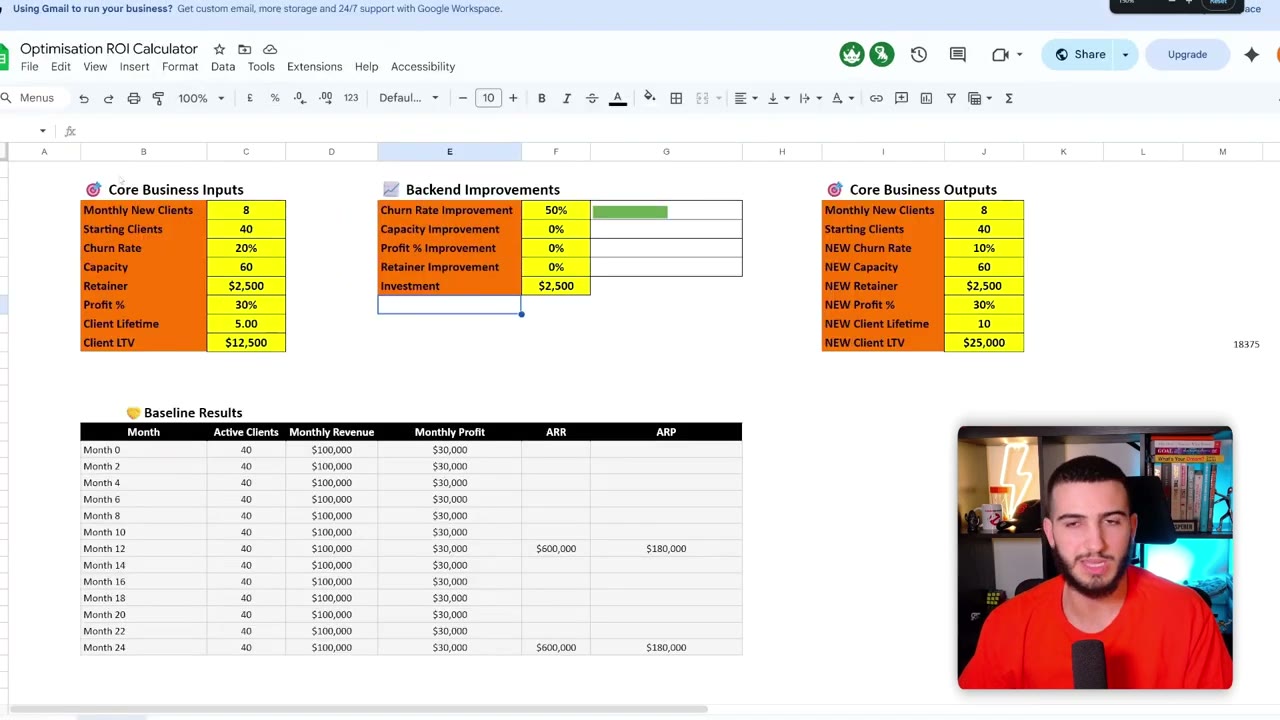
Here is the compounding effect, using a simple model. Start with 40 clients, a capacity of 60, a monthly price of 2,500, a 30% profit margin and an average client lifetime of five months, adding 8 new clients every month.
At 20% churn, adding 8 clients a month only replaces the 8 you lose. The agency stays stuck at the same size for the full two years. At 10% churn, the same sales effort keeps adding to the base month after month until you hit your capacity cap. At that point churn is no longer the constraint.
The ad spend is the same and the cost of servicing clients is the same. Only the retention changes. This is why some agencies keep scaling past their first big month while others hit it once and slide back.
Is your constraint acquisition or retention?
If you can get clients in on a consistent basis, then your constraint is not ads or acquisition. It is keeping the clients you win. Continuing to pour money into acquisition without fixing this is like pouring water into a leaky bucket.
At 20% churn with 40 clients and a cost to acquire of 2,000, you spend 16,000 every month only to stay where you are. You can keep that up for a year or two with heavy ad spend, but it is not sustainable. Focus on the real constraint first.
What are the five hidden costs of churn?
The money is only part of the picture. These costs are easy to miss.
- Word of mouth. Clients in the same niche talk to each other. A trail of clients who leave builds a bad reputation, and that is very hard to outspend. Your ad metrics can worsen without you knowing why.
- Service delivery. Marketing works best over a long relationship. High churn removes the chance to get consistent results over time. A higher lifetime value also lets you invest more in each client, for example in experienced consultants instead of low experience support.
- Team churn. If your team keeps dealing with unhappy clients and complaints, they will not enjoy the job, and good people leave. Then you spend more on recruiting and training.
- Lower conversions. Sales conviction matters. If your sales team sees negative reviews and clients leaving, their belief in the product falls, and so does their close rate.
- Enterprise value. Buyers look at churn. A high churn rate means your agency is valued lower, and a buyer may not be interested at all.
What should you do about it?
Start by tracking your churn rate regularly. Seeing the number is what motivates you to improve client experience. As agencies grow, the personal attention clients got early on can disappear, and that is often when people start leaving.
The good news is that this is not guesswork. There are systems that decrease churn at scale, so you can keep adding clients without hurting the client experience or stressing your team.
Questions people ask
How do you work out the cost of churn for an agency?
Multiply the number of clients you lose each month by their monthly fee to get lost recurring revenue. Then multiply the same number of clients by your cost to acquire a client, since you must replace them to stay level. Add the two together.
What is a good churn rate for an agency?
In the example used here, 10% is described as not the best place to be, and ideally you want to be lower. Under 8% is described as a really good place to be.
Why does reducing churn help an agency grow?
With high churn, new clients only replace the ones leaving, so the agency stays the same size. Lower churn lets the same sales effort build the client base until you reach your capacity, without extra ad spend.
What are the hidden costs of churn?
Damage to word of mouth in your niche, weaker service delivery, team members leaving, lower sales conversion and a lower enterprise value if you ever sell the agency.
Rather have it built for you?
Fluxomate builds internal tools and AI agents for agencies. On your stack, owned by you.
See if you qualify